Support Our Mission
Help support and advance agriculture across Minnesota with a gift to the Minnesota Foundation for Agriculture.
Make a Gift Today
To make a gift, use the link below or send a check payable to the Minnesota Foundation for Agriculture.
Donors may specify on the memo line which area of the Foundation they wish their gift to be used towards, otherwise the donation will be used to meet the overall mission.
Mail your gift to:
Minnesota Foundation for Agriculture
Attn: Ruth Meirick
P.O. Box 64370
St. Paul, MN 55164
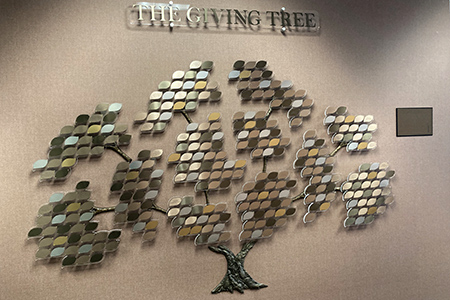
The Giving Tree
In honor of MFBF's Centennial year in 2019, the Foundation unveiled the Minnesota Farm Bureau Giving Tree. Located inside the Minnesota Farm Bureau Center's entrance in Eagan, the Giving Tree displays the donations and gifts that helped to grow the Foundation.
To be recognized on the giving tree, donations begin at $1,000. Other levels include $2,500, $5,000, $10,000 and $25,000.
Contact Foundation Director Ruth Linkenmeyer Meirick at ruth.meirick@fbmn.org to make a gift.
Give in Honor or Memory
A gift in honor or memory of someone special is a meaningful way to celebrate a life, recognize a milestone, or support a cause that mattered to them.
Additional Foundation Gift Programs
Supporting agriculture is about caring for the people and communities behind it. There are many ways to give - today or through your future plans - that help ensure Minnesota's agricultural community remains strong for generations to come. In addition to voluntary donations, below are additional gift programs for individuals or businesses.
Planned Giving
Include us in Your Will or Trust
One of the simplest ways to make a lasting difference is to include the Minnesota Foundation for Agriculture in your will or trust. It costs nothing today and helps ensure future support for Minnesota’s agricultural community.
Name Us as a Beneficiary
You can name the Minnesota Foundation for Agriculture as a beneficiary of a retirement account, life insurance policy, or bank or investment account. This is often as simple as completing a beneficiary form.
Give Land
Land is often one of the most valuable assets in agriculture. Donating land — such as farmland or acreage — can create a meaningful legacy while supporting the future of agriculture.
Give Personal Property
You can donate equipment, vehicles, machinery, or other personal property to support the mission of the Minnesota Foundation for Agriculture. These gifts can be especially meaningful for those who want to give from assets they already own.
Give from a Donor Advised Fund (DAF)
If you have a Donor-Advised Fund, you can recommend a grant to the Minnesota Foundation for Agriculture quickly and easily through your fund provider.
Make a Qualified Charitable Distribution (QCD)
If you are age 70½ or older, you can give directly from your IRA to support the Minnesota Foundation for Agriculture. This option may reduce your taxable income.
Use your Required Minimum Distribution (RMD)
If you are required to take a distribution from your retirement account, you can use those funds to support the Minnesota Foundation for Agriculture and its programs.
Give Through Life Insurance
You can name the Minnesota Foundation for Agriculture as a beneficiary of a life insurance policy or transfer ownership of a policy. This can be a meaningful way to create a lasting gift.
Please contact Foundation Director Ruth Meirick directly with any requests for these specialized gift options.
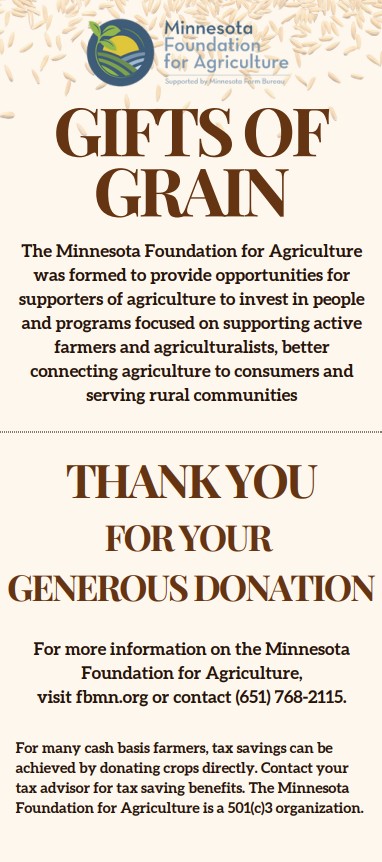
Donate Grain or Commodities
Many farmers choose to donate grain or commodities directly from their operation. This type of gift can be tax-efficient and is a familiar way to support organizations that serve agriculture.
Gift of Grain
Farmers have the option to make a gift of agricultural crops to the Minnesota Foundation for Agriculture. The farmer delivers the crop to the elevator, crop merchandiser or delivers to on-farm storage and uses the form to instruct the elevator to transfer the crop to charity. The charity receives the warehouse receipt and collects proceeds. The farmer can include the production expenses on their tax returns. View Printable Version